
Waterproof vinyl plank flooring
A Practical Flooring Option for Everyday Living
Waterproof vinyl plank flooring offers a flooring option designed to combine attractive finishes with practical everyday use. Explore the available styles, installation requirements, and considerations for your home.
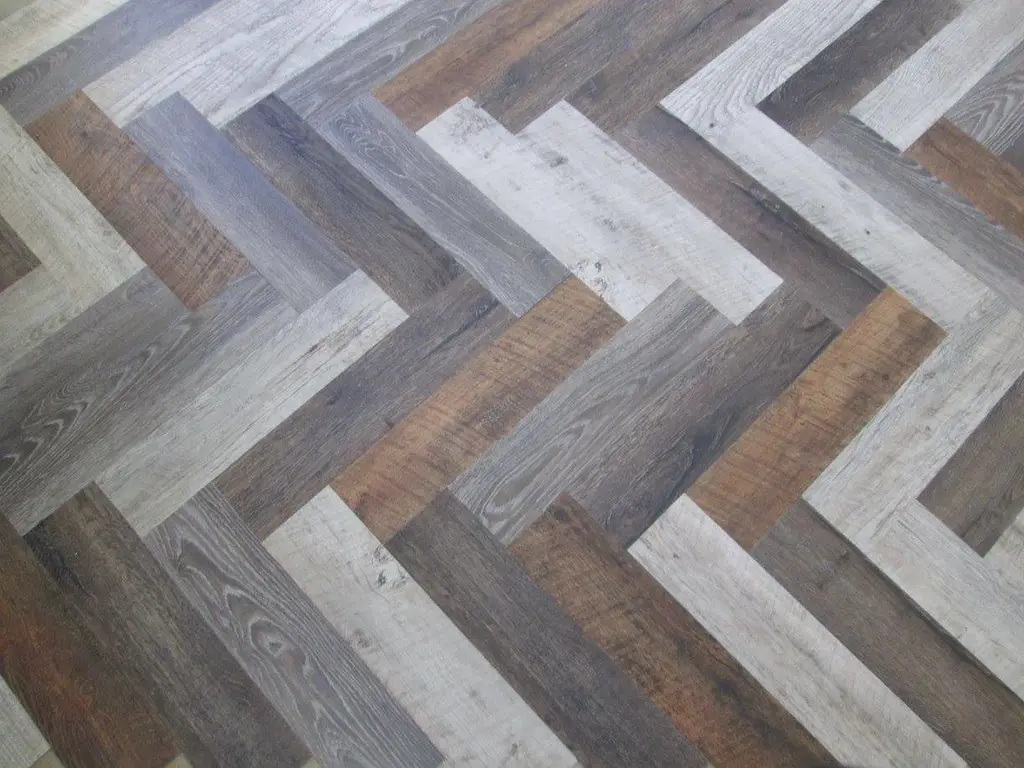
Vinyl planks in a herringbone pattern, in a flooring company’s showroom. Photo: “New SBF Showroom Floor – Vinyl Planks in Herringbone Pattern” by Slaughterbeck Floors, Inc., resized, licensed CC BY 2.0.
The basics
What is waterproof vinyl plank flooring?
Luxury vinyl plank (LVP) is a resilient floor made in plank shapes. It is built in layers: a clear wear layer on top, a printed design layer that looks like wood or stone, a core, and sometimes a pad attached underneath.
Rigid core: WPC and SPC
Many planks sold as waterproof have a rigid, plastic-based core. WPC has an expanded (foamed) polymer core and SPC a solid polymer core. Flexible vinyl planks that are glued down also exist. How the planks lock together, and whether they float or are glued, depends on the product.
How is it different from hardwood?
Wood takes on and gives off moisture from the air, so it swells and shrinks, which can open gaps in a floor. For example, one wood flooring installation guide says its products are not appropriate for full bathrooms.
How is it different from laminate?
Laminate looks similar, but its core is made of compressed wood fibers. The laminate industry’s own association says laminate is not suitable for bathrooms unless the manufacturer specifies it as waterproof.
Why can it handle water?
Makers of waterproof planks say water on the surface will not make them swell or buckle. But construction and performance vary by manufacturer and product line, so always check the specific product’s documents.
Potential benefits
What it can offer, and the fine print
Moisture resistance
The planks are built on a plastic-based (polymeric) core instead of wood fibers. In manufacturers’ words, “waterproof” means the planks keep their structural integrity when water gets on them.
That does not make the room waterproof. Manufacturers say plainly that the floor is not a moisture barrier for the subfloor, walls or anything around it. Water can still get underneath at the edges, around pipes and from below.
Appearance
A printed design layer, often with texture pressed in to match the pattern, recreates the look of wood or stone. Colors, plank sizes and textures depend on the product line, so look at real samples before you decide.
Cleaning and upkeep
Brands disagree here. Some say to use a neutral-pH cleaner and never ammonia; another recommends a non-sudsy ammonia cleaner. Some allow steam mops and others do not. Several agree on one thing: do not flood the floor or leave standing water on it.
Use the care guide for your exact product.
Everyday durability
A clear wear layer on top protects the printed design. Its thickness is listed in mils (thousandths of an inch) on each product’s spec sheet, for example 12, 20 or 22 mil in one brand’s range. Compare the wear layer and the warranty of the actual products you are considering.
Comfort and sound
Some products come with a pad already attached to reduce noise underfoot; others do not, and some brands say not to add a second pad. Sound and comfort figures are specific to each product, so check its spec sheet.
Installation
Rigid-core planks usually click together and “float” over the subfloor; other products are glued down. Each brand sets its own rules for flatness, expansion gaps and which existing floors it can go over. Several say never to lay it over carpet.
Before you choose
Is it right for your bathroom?
Vinyl plank can work well in many bathrooms, but not every product is approved for every room. Check these with the specific product in mind:
Approved for bathrooms?
Read the product’s installation guide. Some allow full bathrooms with extra steps; one brand says not to install in rooms with floor drains or sloping floors, which matters next to a curbless shower. Some exclude rooms prone to flooding.
Subfloor condition
The subfloor must be flat within the brand’s limits (often about 3/16 inch over 10 feet) and solid. Old resilient floors and adhesives can contain asbestos, so they must be checked before anyone sands or scrapes them.
Moisture
On a concrete slab, manufacturers require moisture testing (ASTM F1869 or F2170), each with its own limits. In bathrooms they require the edges to be sealed with caulk (most specify 100% silicone), including along tubs.
Toilets, vanities and cabinets
Some brands allow planks under a toilet with a gap and silicone at the flange; many say permanent cabinets and vanities should not sit on top of a floating floor.
Transitions
Plan how the new floor meets the next room. A low, smooth transition matters if anyone uses a walker, cane or wheelchair.
Slip resistance
Like other smooth floors, vinyl can be slippery when wet, and manufacturers rarely publish a wet slip rating. No floor is slip-proof and no floor prevents falls. Keep it dry and wipe up water quickly.
Cleaning
Pick a product whose care routine you are happy to follow, and keep its care guide.
Warranty
Water coverage is usually limited to water on the surface. Most of the warranties we read exclude flooding, and several also exclude plumbing and appliance leaks and damage to subfloors and walls. One brand’s “floodproof” warranty does cover the planks after household overflows and leaks, but still excludes walls and subfloors, and storm, hurricane and broken-pipe flooding.
The whole design
Color, plank direction and how the floor meets the shower, tub and walls all affect how the finished bathroom looks and works.
See it in person
Colors and textures are best seen up close
Photos cannot show texture, gloss or true color. Ask to see real samples in your own light, next to your wall and shower colors.
Photo of waterproof vinyl plank flooring coming soon.
Common questions
Is waterproof vinyl plank flooring suitable for bathrooms?
It can be, when the specific product is approved for bathrooms and installed the way its maker requires. Manufacturers call the planks waterproof because water on the surface does not damage them, but they also say the floor is not a moisture barrier for the subfloor or walls. In bathrooms they require the edges to be sealed with caulk, and most of their warranties exclude flooding (one brand’s “floodproof” warranty covers the planks after household overflows, but not walls, subfloors or storm and broken-pipe flooding). Some products are not approved for rooms with floor drains or rooms prone to flooding, so check the installation guide for the exact product.
What is the difference between vinyl plank and laminate flooring?
Both can look like wood. Vinyl plank has a plastic-based core, while laminate has a core of compressed wood fibers. The laminate industry’s own association says laminate is not suitable for bathrooms unless the manufacturer specifies it as waterproof.
How do you clean waterproof vinyl plank flooring?
Follow the care guide for your exact product, because brands disagree. Some say to use a neutral-pH cleaner and never ammonia, while another recommends a non-sudsy ammonia cleaner; some allow steam mops and others do not. Several agree that you should not flood the floor or leave standing water on it.
Is vinyl plank flooring slippery when wet?
It can be. Manufacturers warn that vinyl, like other smooth floors, can be slippery when wet, and they rarely publish a wet slip rating. No floor is slip-proof, so keep bathroom floors dry and wipe up water quickly.
Where this information comes from
Manufacturer installation guides, warranties and care guides, and industry and government sources, checked in October 2026. Product rules change, so always follow the documents for the exact product you choose.
- Resilient Floor Covering Institute (RFCI): flooring types
- ASTM F3261, Standard Specification for Resilient Flooring in Modular Format with Rigid Polymeric Core
- North American Laminate Flooring Association (NALFA): What is laminate?
- USDA Forest Products Laboratory, Wood Handbook, chapter 4
- Mohawk SolidTech limited warranty and care instructions
- Mohawk SolidTech R warranty (floodproof coverage and its limits)
- COREtec Pro (Shaw) residential installation guidelines for SPC products
- COREtec Pro residential maintenance guidelines
- Mannington ADURA Max installation guide (2024)
- Mannington ADURA Max limited warranty (2023)
- Armstrong Flooring / AHF rigid core SPC locking installation system
- LifeProof rigid core vinyl plank installation guide (2023)
- Clemson University and TCNA, wet slip resistance of resilient flooring (2019; products bought 2018–19)
Take the next step
Explore Flooring Options for Your Home.
Let’s discuss the available flooring options and determine which products may be appropriate for your project.